

Multi-hyphenate creative Malynda Hale continues to redefine what it means to lead with purpose. An actress, singer-songwriter, director, podcast host, activist, and mother, Hale has built a career rooted in authenticity, advocacy, and meaningful storytelling.

This summer, Hale stars as LouEster Sadie Gibbs in the powerful drama Bull Street, releasing on Amazon Prime and Fandango July 17, 2026. The film stars Oscar winner Amy Madigan, Loretta Devine, Arielle Prepetit, and Gary Ray Moore, following an Ivy League lawyer whose challenge to her family’s longtime home ignites a courtroom battle over privilege, legacy, and generational ownership.

Bull Street has already made an impact on the festival circuit with premieres at the Pan African Film Festival and the Sarasota Film Festival. Beyond acting, Hale recently completed production on her second directed feature, Au Gratin, starring Tiffany Daniels, Loretta Devine, and Jay Donnell. She also continues to amplify Black voices through her photo and video series Black Voices Heard, host meaningful conversations on her podcast #WeNeedToTalk, and create uplifting music that reflects her passion for inspiring others.
In this exclusive conversation with FEMI Magazine, Hale discusses Bull Street, the importance of preserving Black stories, motherhood, and why today’s women are no longer waiting for permission to lead.

What drew you to the role of LouEster Sadie Gibbs in Bull Street, and what made this character stand out to you personally?
Malynda Hale: Honestly, it was the fact that I hadn’t played a character like her before, but it felt familiar to me at the same time. She carries the weight of family legacy and the complicated relationship between where you come from and who you are trying to become, while also honoring her family’s legacy in a way that makes them and herself proud. I am always drawn to characters who have an internal conflict that’s relatable, and that’s what I really felt with her. She gave me something real to work with, and I think audiences will recognize themselves in her in ways that may surprise them.
Bull Street explores themes of privilege, legacy, and family history. Why do you think these conversations are especially important right now for women of color?
Malynda Hale: We are living in a moment where so much of what we thought was settled is being actively dismantled, so I think this movie is timely and necessary. Specifically, because this story is really centered around Black women and what we own, what we stand to lose, and what was taken from us. The conversations about legacy and who gets to build wealth, who gets to claim history, and who gets to define their own narrative are very relevant.
You worked alongside powerhouse actresses like Loretta Devine and Amy Madigan. What was the most valuable lesson you took away from that experience?
Malynda Hale: I think what I took away from working with them was their commitment and love for the art of acting. I really valued that so much. Loretta Devine, who I’m still very close to, taught me that longevity in this industry comes from showing up ready, dedicated, and committed every single time. I loved learning from both of them because they brought everything they had to every take. Watching them both work really was a masterclass, and I feel very grateful.
Your upcoming project Au Gratin continues your work in storytelling centered around meaningful voices and experiences. What types of stories are you most passionate about telling at this stage of your career?
Malynda Hale: I am most passionate about telling stories that normalize experiences for all demographics. I want to see more stories about people who have been told their lives are not cinematic enough, or their love is not universal enough, or their struggle is too niche. I think it’s important to see people who look like me exist in all scenarios, not just ones centered around trauma or stereotypes. Au Gratin is the second film I’ve directed, and it’s drastically different from the first. It’s a story about family and the chaos that comes with being together for the holidays. It’s a deeply human story and extremely universal.
Through your web series Black Voices Heard, you amplify the experiences of Black Americans. What inspired you to create this platform, and what impact do you hope it leaves?
Malynda Hale: I created it because I was tired of Black stories being filtered through someone else’s lens before they reached an audience. I wanted a space where Black people could speak for themselves without translation or palatability. The impact I hope it leaves is for anyone who never saw themselves represented fully to feel a little representation from these stories.
Your podcast #WeNeedToTalk tackles current events and difficult conversations. How do you balance honesty, vulnerability, and responsibility when discussing sensitive topics publicly?
Malynda Hale: I always lead with my own experiences. I don’t try to paint myself as an expert but as someone who is able to process in real time, hold nuance, make mistakes, and learn. People don’t trust voices that never show their own uncertainty. So, I try to lead with my values and model what it looks like to have humility and awareness at the same time because I think that is extremely important.
As a Black woman raising two daughters during and after the pandemic, how has motherhood shaped your perspective on empowerment, identity, and resilience?
Malynda Hale: My daughters are my reason for everything. Before them I could talk about the world I wanted to build, but now it is personal in a way that changes how I show up every single day. I want them to grow up knowing their mom did everything she could to build a world for them that’s free from ridicule and judgment. That it is possible to achieve your dreams, drown out the noise, and keep going.
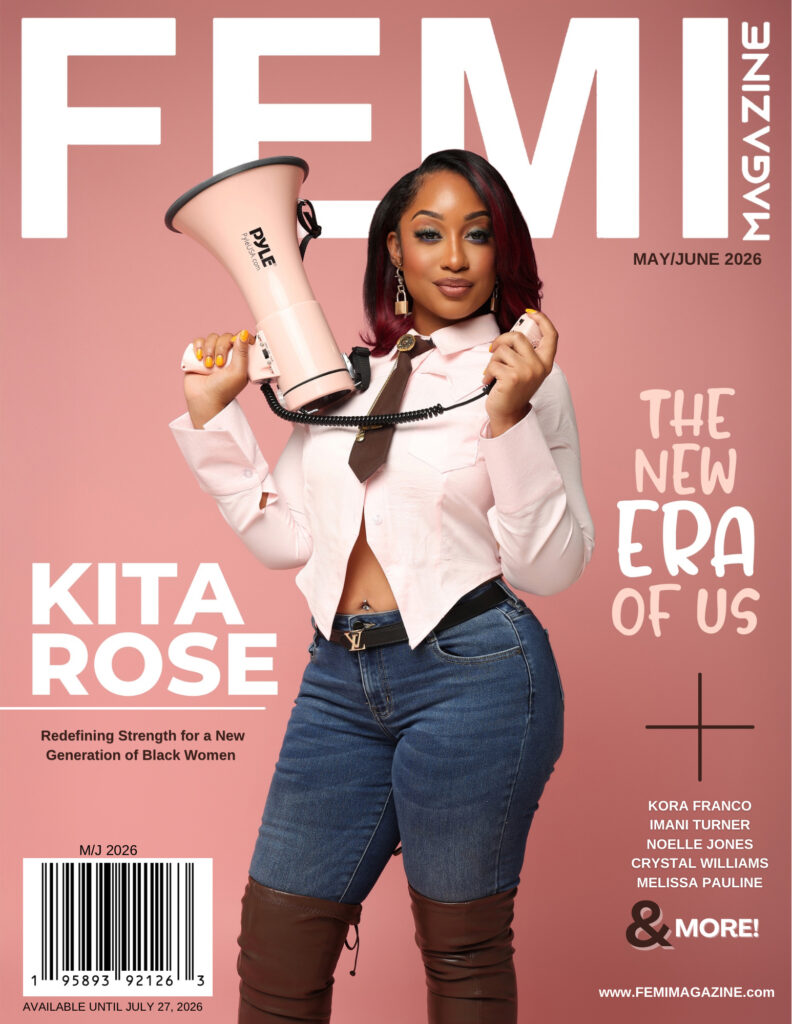
FEMI Magazine’s recent print issue focused on A New Era of Us, celebrating the evolving experiences, leadership, and influence of women of color. What does this new era mean to you, and what changes are you most hopeful to see for the next generation of women?
Malynda Hale: I think this new era means we’re not waiting for permission to do anything anymore. We are building our own tables, funding our own films, telling our own stories, and creating opportunities for ourselves and others that certain people won’t give to us. We’ve seen a lot of regression, but I hope that my daughters’ generation won’t have to fight the same fights we fought. That the doors we are opening right now and, in some cases, kicking down, will simply be open for them.

As women continue to reshape industries, preserve their stories, and build opportunities for future generations, voices like Malynda Hale’s remind us that legacy isn’t simply inherited. It’s created through courage, vision, and the willingness to tell the stories that matter.
Photography Credit: Brie Childers
Follow Us On Social Media!


